

What You Should Consider Before You Build
At a recent site visit, a customer asked me a question that caught me by surprise: “Are golf simulators noisy?” I was actually glad they asked. I have countless conversations with people planning golf simulators, and we spend a lot of time talking about ceiling height, screen size, launch monitors, projectors and software. Noise, however, rarely comes up. It is subjective, but it can have a major impact on how well a residential simulator works for the people living around it.
The simple answer is yes. Golf simulators can be noisy. I am not going to sugarcoat that. I have spent much of my career in professional audiovisual systems, where understanding how sound behaves within and between rooms is part of designing spaces properly. That background naturally influences the way I think about golf simulator rooms at SimCaddy. The important thing is understanding what can be improved acoustically and what cannot.
The Two Dominant Impact Sounds
Every golf shot in a simulator produces two dominant sounds very close together. First, the clubface strikes the ball. Then, a fraction of a second later, the ball hits the impact screen. The clubface impact can be surprisingly sharp, especially with driver, while the screen produces a heavier thump. Depending on the screen tension and turf, the ball falling to the floor can create additional noise.
Put those sounds together and repeat them throughout a practice session and you begin to understand why simulator noise becomes noticeable. One shot probably is not going to bother anyone. Repeated shots while somebody upstairs is reading, watching television or trying to sleep can be a very different story. For the golfer, you get used to it quickly. For everybody else in the house, maybe not.
Acoustic Treatment Is Not Sound Isolation
This is probably the most important distinction to understand. Acoustic treatment improves the sound inside the simulator room. Sound isolation is about reducing how much of that sound travels into other spaces. They are not the same thing.
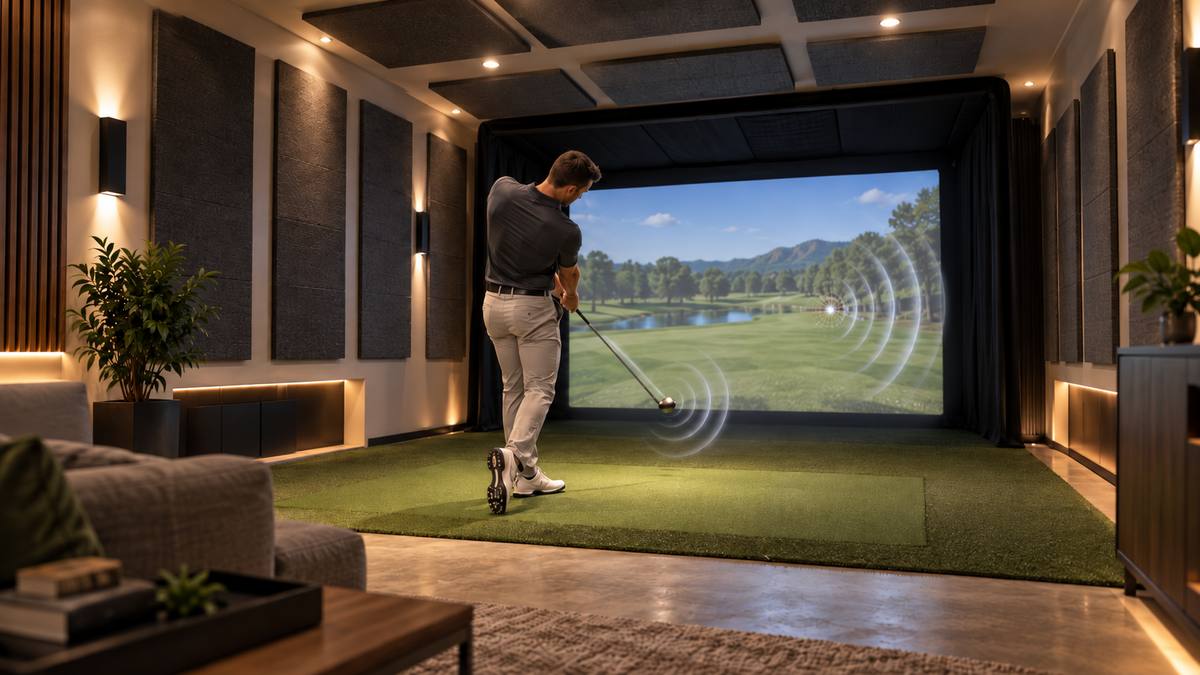
Hard surfaces such as drywall and concrete can cause sound to bounce around a room, making it feel harsh and reverberant. Golf simulator installations often include padded or absorptive materials that serve a dual purpose: protecting walls and ceilings from errant golf balls while helping to reduce sound reflections. Proper acoustic treatment can make the room much more comfortable and may also lower the overall sound energy within it.
But acoustic treatment does not make a room soundproof. True sound isolation is primarily a building construction issue involving walls, floors, ceilings, doors, insulation and the many paths through which sound can travel.
 Why Sound Can Travel Through the House
Sound does not necessarily stay where you expect it to. It can travel through ductwork, floors, ceilings, framing and other structural connections. In acoustics, these are often referred to as flanking paths. That means you can have substantial wall construction around a simulator room and still hear the impact somewhere surprisingly far away.
I know this firsthand. My simulator is in my basement, and the room has substantial construction, including double studded walls. Even so, the sound can still be heard two stories above me. My house, like most houses, is an interconnected structure, with ductwork, floors, framing and other physical connections that allow sound and vibration to travel.
There are evenings when I would love to go downstairs and hit some balls, but I don't because a family member is home and doesn't particularly want to listen to it. That is real life with a residential golf simulator. It is also why I would never tell a customer that simply adding acoustic panels will solve the noise problem. They can improve the room, but they cannot completely isolate it from the rest of the house.
Where Is the Best Place to Put a Golf Simulator?
If noise is an important consideration, location can make an enormous difference. From an acoustics and lifestyle perspective, this is how I generally think about residential simulator locations.
IDEAL:
A purpose-built detached golf building or golf shed. This gives you the greatest control over the dimensions, sound, lighting, heating, cooling and simulator environment. Most importantly, it separates the simulator from the main living space.
VERY GOOD:
A detached garage. A detached garage offers many of the same advantages. Physical separation can solve a significant portion of the lifestyle issue before you spend money trying to manage acoustics inside the simulator room.
GOOD:
An attached garage. An attached garage can be an excellent choice, particularly when it is positioned away from bedrooms and primary living spaces. Sound can still travel through connected walls and framing, but it is often a better starting point than a room directly inside the main living area.
MORE COMPROMISED:
A basement or main-floor recreation room. These spaces can make fantastic golf simulators. Mine is in my basement, and I would not want to be without it. But other occupants are more likely to hear you playing, especially if bedrooms, offices or living spaces are nearby.
None of these locations is inherently right or wrong. The point is that physical separation is one of the most effective tools you have when dealing with simulator noise.
Look Beyond the Simulator Room
Before deciding where your simulator will go, look at everything around it. What is directly above you? What is on the other side of the wall? Is there a bedroom, home office, television room or quiet reading area nearby? And when are you most likely to use the simulator?
If most of your golf is going to happen in the evening, those relationships become even more important. A room can have excellent dimensions for golf and still be a poor location acoustically.
That is why one of the most important questions is not simply, “Can I fit a golf simulator here?” It is, “Where is the sound going to go?”
Manage the Noise, But Be Realistic
There are things we can do. We can treat reflective surfaces, use acoustic and padded materials, think carefully about the impact screen and choose the location intelligently. If preventing sound from travelling into the rest of the house is a critical requirement, however, sound isolation should be considered as part of the building construction itself.
A home golf simulator can be an incredible addition to a house. I would not want to be without mine, but it is worth thinking beyond the golfer when planning one. Consider the people living around it, the rooms beside it and above it, and when you are going to use it.
Golf simulators make noise. That does not make them any less enjoyable. It simply makes acoustics one more important part of designing them properly.
About the Author
Tom Murray is the founder of SimCaddy, a Certified Technology Specialist (CTS), and a passionate golfer with a keen interest in golf technology and game improvement. Combining professional audiovisual design principles with real-world simulator experience, Tom helps golfers navigate the complexities of launch monitors, projection systems, simulator software, gaming PCs, and room design. Through SimCaddy, Tom focuses on helping golfers understand what is possible and creating simulator experiences that deliver lasting value.
Share:
Your Most Valuable Golf Simulator Investment Isn’t Technology. It’s Space.